
The people who built Oktoberfest
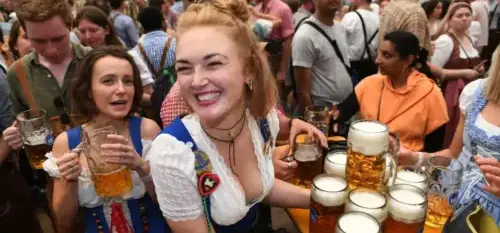
In 216 years a lot of interesting characters have strolled, stumbled, and crawled across Munich’s famous Theresienwiese. So take a step back, grab a Maß (pronounced “Mahss”—the traditional 1-liter glass mug, not a ceramic “stein”), and walk, stumble, and crawl through history alongside the remarkable figures who transformed a simple horse race in a muddy German field into the largest celebration of beer the world has ever seen.

(Prince Ludwig and Princess Therese of Saxe-Hildburghausen)
The event began in October 1810 as an over-the-top royal wedding celebration for . Because Munich was the grand capital of their kingdom, Prince Ludwig and his father, King Maximilian I Joseph, decided to throw the party of the century right on the city’s doorstep. Among the noble guests gracing the inaugural festivities was King Max Joseph himself—a beloved, eccentric monarch who regularly strolled Munich’s streets unaccompanied to chat with commoners. He enthusiastically hosted the entire city on the meadow named after his new daughter-in-law, a bride who had traveled down from Saxe-Hildburghausen, a small duchy just north of Bavaria famous for its rolling green hills and dense forests. The main attraction wasn’t a vast beer hall, but a high-stakes horse race that sent dust flying across the open grass—a horse race that would even impress NBA superstar and horse-racing fanatic Nikola Jokić. The royal family enjoyed the spectacle so much that they decreed the party an annual affair.
Originally, this grand horse race was held in mid-October—the inaugural run took place on October 17, 1810. The race became a repeating event because the Bavarian National Agricultural Association recognized its massive popular appeal and stepped in to organize and sponsor it the following year in 1811, pairing it with an agricultural show to promote Bavarian farming. As the years rolled on, however, the brutal autumn weather began to cooperate less and less. Miserable, freezing October rainstorms repeatedly washed out the fairgrounds, ruining turnout and turning the meadow into a muddy swamp.
This is where pioneering Munich brewer Josef Sedlmayr became one of many individuals who would indelibly put their mark on the festival. In the early 1870s, Sedlmayr, owner of the Franziskaner Brewery, pitched a revolutionarily simple solution to the weather problem: pull the festival’s start date back into mid-September to capitalize on the longer, warmer, and sunnier late-summer days, leaving only the festival’s grand finale to spill into early October.

(Josef Sedlmayr, the visionary brewer behind Märzen. Source: Brookston Beer Bulletin)
What flowed into the glass during those early festivals was dictated entirely by strict Bavarian brewing laws. Under a 1539 decree, brewing was strictly banned between April 23 and September 29 because summer heat spoiled wild yeast. To prepare for the dry summer months, brewers spent March crafting extra-strong, heavily hopped batches known as Märzen (March beer), stashing them in deep rock caves filled with mountain ice. By late September, these long-cellared, aged lagers were tapped to clear the barrels for the autumn harvest. Rich, malty, amber, and packing a heavy caramel profile, Sedlmayr perfected this style at Franziskaner, making Märzen the undisputed official liquid of Oktoberfest for a century.
Here at our store, when our annual shipment of German Oktoberfest imports arrives in mid-August, we owe a direct debt to Josef Sedlmayr. Those bottles arriving on our shelves have become our own unofficial herald of the waning Maine summer.
How many German physicists does it take to screw in a lightbulb? Just one, and you probably recognize his name… Einstein. Long before he was unraveling quantum mechanics, a 17-year-old Albert Einstein spent his late summer in 1896 climbing wooden ladders across the fairgrounds. Working for his father’s electrical company, young Albert manually screwed in lightbulbs and wired fixtures for the famous Schottenhamel tent, bringing electric light to Oktoberfest for the very first time. While Einstein was busy illuminating the grounds, thousands of partygoers were nearby with their own heavy Maß full of delicious German lager—proving you don’t have to be a genius to enjoy Oktoberfest.

(Teenage Albert Einstein)
By 1950, Munich Mayor Thomas Wimmer established the festival’s most famous opening ritual. On opening day, Wimmer marched into the Schottenhamel tent, swung a heavy wooden mallet, and attempted to manually drive a brass spigot into the first wooden keg. It took him nineteen sweaty, desperate blows—a glorious, chaotic spectacle that created an ironclad tradition. Today, no reveler can touch a single drop of beer until the reigning mayor taps the keg and bellows “O’zapft is!” (“It is tapped!”).
Behind the scenes, however, a massive shift in beer styles was brewing. As beer consumption steadily climbed, revelers demanded an easier-to-drink style of beer that wouldn’t fill them up like a liquid loaf of bread on warm September afternoons. Modernizations in German brewing laws and malt processing regulations allowed for a lighter malt profile, paving the way for a brand-new style: Festbier. In the 1970s, Paulaner introduced this paler, crisper, golden-hued lager designed for pure quaffability.
Traditionalists pushed back, but brewmasters countered with practical drinker logic. Renowned German brewing historian and author Horst Dornbusch captures the exact shift that redefined the fairground taps:
“The modern Oktoberfest beer is golden, not amber. It was introduced in the 1970s by Paulaner because the traditional Märzen was deemed too filling for a long day of drinking in the tents. Drinkers wanted something lighter in body, less sweet, and easier to drink in large quantities.”
| Feature | Märzen (Traditional) | Festbier (Modern) |
| Color | Deep amber to copper | Deep golden to pale yellow |
| Taste | Rich, malty, bread-crust sweetness with heavy caramel notes | Crisp, clean, subtly sweet with toasted bread notes and a smooth finish |
| ABV | 5.8% – 6.3% | 5.8% – 6.3% |
By the 1990s, Festbier had officially dethroned Märzen as the standard pour on the fairgrounds. Strict German legal tradition dictates that only six historic Munich breweries located within city limits can serve beer on the grounds: Spaten, Hacker-Pschorr, Paulaner, Hofbräu, Augustiner, and Löwenbräu. Noticeably absent from this “Big Six” is Weihenstephaner. Even though Weihenstephaner is world-renowned as the oldest continuously operating brewery in the world (founded in 1040), it is located in Freising, just outside Munich’s official city boundary, disqualifying it from serving inside the tents!
Despite its legendary status today, an uninterrupted annual party was far from inevitable. Pulling off a global spectacle of this scale takes tons of dedicated work, and throughout its history, Oktoberfest has been canceled a total of 26 times due to war, disease, economic collapse, and global crisis:
-
1813: Cancelled due to Bavaria’s involvement in the Napoleonic Wars.
-
1854 & 1873: Cancelled during major cholera epidemics in Munich.
-
1866 & 1870: Cancelled due to the Austro-Prussian War and Franco-Prussian War.
-
1914–1918: Suspended throughout World War I.
-
1919–1920: Downsized to a modest “Autumn Fest” (Kleineres Herbstfest) without proper Oktoberfest beer as Germany recovered.
-
1923–1924: Cancelled due to severe hyperinflation during the Weimar Republic.
-
1939–1945: Suspended throughout World War II.
-
1946–1948: Replaced by smaller post-war “Autumn Fests”.
-
2020 & 2021: Cancelled for two consecutive years due to the COVID-19 pandemic.
When the festival does return, however, the world shows up in full force. The single highest attendance record stands at 7.2 million visitors, set in 2023—bolstered by two extra festival days intersecting with Germany’s National Day of Unity and pent-up enthusiasm following its pandemic pause.
Not every notable guest receives a warm Bavarian welcome. The festival was started for a German princess, but when America’s princess Paris Hilton showed up in 2006 to promote her canned prosecco wearing a shiny dirndl, the red carpet was NOT rolled out. Appalled by the blatant commercialization and disrespect to traditional alpine dress, municipal organizers issued Hilton a permanent lifetime ban, proving that Bavarian tradition strictly overrides Hollywood publicity stunts.

(Paris Hilton 2006)
Other celebrities fared much better. Hollywood icon and Austria’s own Arnold Schwarzenegger, a regular visitor to the Marstall tent, once stepped up onto the stage and casually conducted the tent’s 20-piece brass band using a giant baked pretzel as a baton. Pop star Katy Perry once attempted to blend in by wearing a traditional dirndl, only to cause a frenzy when she dove headfirst into the crowd, while legendary actor Samuel L. Jackson delighted tent revellers by gamely lifting a pair of heavy one-liter Maß glasses to toast the room.
Between celebrity antics, flowing Festbier, and the inevitable Bierleichen (“beer corpses”) napping on the grassy hills, Oktoberfest remains a gloriously wild evolution of a 1810 royal wedding.
From a royal wedding hosted by King Max Joseph and Prince Ludwig for Princess Therese, to the weather-savvy genius of Josef Sedlmayr, the teenage electrical work of Albert Einstein, Mayor Wimmer’s 19-stroke keg tap, and even the banned antics of Paris Hilton—Oktoberfest has always belonged to the characters who bring it to life.
While the official celebration in Munich doesn’t kick off until later in September, we strongly encourage you to grab your bottles early. Despite importing more and more German lagers each year, we can never quite slake the thirst of our BowtOberfest enthusiasts, and these limited shipments vanish fast.
If you want to sip a true piece of brewing history this autumn, don’t wait until the mayor taps the keg—stop in today, grab your favorite Märzen or Festbier, and make sure your glass is full before the season sells out!
