
Ghost Ships, Cold Ice, and High Spirits: The Eternal Mystery of Maine’s Lost Privateer
There is a precise moment along the Maine coastline—somewhere between the jagged white-pine tree line and the iron-gray chops of Casco Bay—where history stops acting like a textbook and starts tasting like a gothic thriller. The tide here doesn’t gently roll in; it moves with heavy, mechanical weight, smelling of kelp, crushed granite, diesel, and cold Atlantic salt. It is a landscape carved by brutal winters, primeval timber, and pure, unadulterated human stubbornness.
Long before Maine was crafting small-batch pot-still spirits or drawing summer crowds for lobster rolls, it was an isolated, wind-scoured frontier province defined by white-oak shipbuilders, ruthless privateers, and the dark trade winds of the early 1800s. And standing taller than any other legend in Maine’s maritime canon is the Dash—a vessel built on sheer speed, steeped in wartime violence, and swallowed whole by an Atlantic storm that never truly surrendered her.
1813: White Oak, Iron Men, and Apex Predators of the North Atlantic
To understand the Dash, you have to strip away the romanticized calendar art of 19th-century sailing and look at the brutal reality of Maine during the War of 1812.
This was a territory pinned against the edge of the continent. Bordering British North America (what we now call Canada), Maine’s coastal communities lived in a state of high-wire economic embargo, naval blockades, and constant military tension. But where British frigates saw a coastline to be choked off, Freeport shipbuilders saw an opportunity to engineer the ultimate apex predator of private enterprise: the privateer.
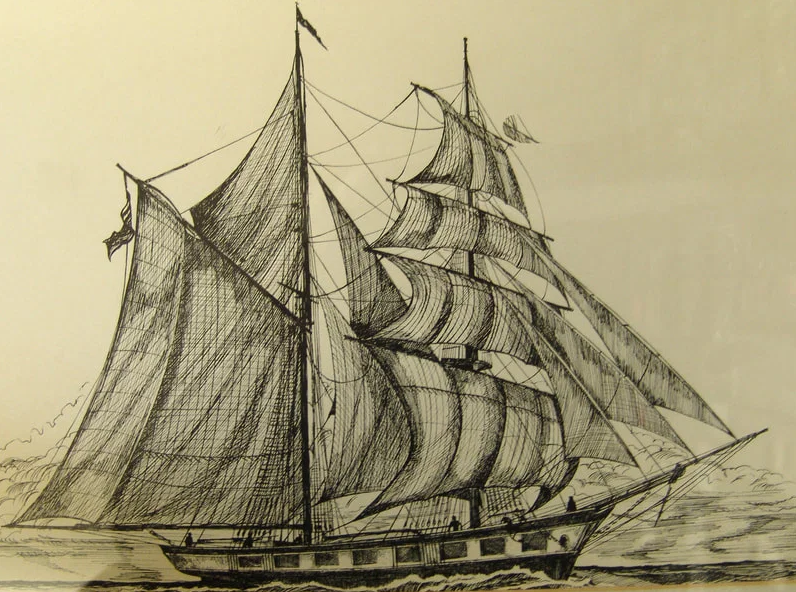
In 1813, master shipwrights Porter Wright and Seward Porter laid the keel for a topsail schooner along the banks of the Royal River. Crafted from dense Maine white oak and virgin pine, the Dash was non-negotiably engineered for a single purpose: unforgiving, terrifying speed. Rigged with sprawling canvas sails that towered over her deck and armed with heavy naval cannon, she was designed to out-run anything she couldn’t out-fight, and out-fight anything she couldn’t out-run.
What followed over her next six cruises was the stuff of naval fever dreams. Under legendary, rock-ribbed commanders like Captain George Bacon and Captain William Cammett, the Dash didn’t just survive the British blockade—she humiliated it.
She sliced through freezing Atlantic squalls, stalking enemy shipping lanes from the Grand Banks down to the Caribbean. Her crew—sixty-odd granite-jawed Maine tars, gunners, and local Freeport boys—operated with surgical, deadly precision. Over fifteen merchantmen and armed British vessels were captured or destroyed under her colors. Millions of dollars in looted enemy cargo—punches of rum, bolts of silk, gunpowder, and hardwoods—were hauled back into American ports.
Yet, the most staggering detail of her battle record isn’t the wealth she seized; it’s her body count. Through fifteen high-stakes naval engagements against the formidable Royal Navy, the Dash suffered zero combat deaths and not a single wounded crewman. In an era where naval warfare meant splinters the size of bayonets and cannonball-shattered limbs, her crew seemed completely invincible. To the sailors who watched her streak across the horizon, the Dash wasn’t just a lucky ship—she felt touched by the supernatural.
Liquid History: Smuggling, Caribbean Molasses, and Maine’s Early Spirit Trade
Privateering was never just about patriotic duty; it was about cold, hard commerce and the thirst for liquid gold. In the early 1800s, Maine’s economy was inextricably bound to a global web of spirits, timber, and illicit trade. Smuggling rum, grain, and timber across Canadian lines during wartime embargoes was practically a regional pastime, and the very merchants funding vessels like the Dash were the ones controlling the docks.
Fleet privateers served as the heavily armed muscle protecting these liquid trade routes. Vessels built in Casco Bay shipped out Maine white-pine timber, granite, and dried cod, returning with holds stuffed full of raw Caribbean molasses, French brandies, Jamaican rums, and Spanish fortified wines.
Coastal Maine towns were lined with copper pot stills converting that imported molasses into navy-strength rum—fuel for shipbuilders, sailors, and timber men warding off the damp Atlantic chill. The lineage of Maine’s modern craft distillation revival—from rich, dark rums and botanical gins infused with local spruce tips to small-batch rye whiskeys aged in local oak—runs directly through these 19th-century privateer trade routes.
Sensational Ink, The Ice Monopoly, and “Remember the Maine”
The same sea lanes blazed by Maine’s privateer fleet eventually became highways for the state’s most notorious export: Kennebec River ice. Throughout the 1800s, Maine held an absolute, cold-blooded monopoly on natural ice, harvesting millions of tons of pure, crystal-clear frozen water to ship across the globe. Bath native Charles W. Morse—the infamous “Ice King”—built a formidable syndicate that weaponized Tammany Hall kickbacks and dockland sabotage to corner the market. As documented in congressional records detailing Charles W. Morse and the American Ice Company cartel, Morse’s empire faced fierce public outrage and federal scrutiny for artificially doubling ice prices in tenement slums during sweltering summers, crushing independent competitors, and enforcing dirty business practices across the Atlantic seaboard. When politicians in Washington and corrupt bosses in New York schemed over whiskey, the crystal-clear ice clinking in their glasses almost certainly came straight from the Kennebec. Decades later, that same brand of corporate ruthlessness turned a naval tragedy into a global war. On February 15, 1898, the battleship USS Maine exploded in Havana Harbor, killing 266 sailors. While modern naval forensics prove it was an accidental coal bunker fire, media barons William Randolph Hearst and Joseph Pulitzer unleashed “Yellow Journalism” to sell papers, fabricating Spanish submarine attacks and whipping the public into a frenzy with a battle cry so catchily rhymed it practically guaranteed a war: “Remember the Maine, to Hell with Spain!” (Let’s be honest: if the battleship had been named the USS Connecticut, the rallying cry—and the classic cocktail it inspired—would have died on the barroom floor for lack of a decent rhyme.)
The sensational headline birthed the legendary “Remember the Maine” cocktail:
-
2 oz American Rye Whiskey (bringing a bold, spicy, oak-aged backbone)
-
3/4 oz Sweet Vermouth
-
1/4 oz Cherry Liqueur
-
Absinthe rinse (a herbal, mysterious whisper on the nose)
Crucially, this drink demands a dense, crystal-clear piece of ice to control dilution while stirring. The pristine clarity of that ice block isn’t just a modern mixology flex—it’s a direct homage to the crystal-clear Kennebec ice that fueled 19th-century saloons and forged Maine’s frozen empire.
Loose Lips, Unseen Shoals, and the Vanishing of The Dash
They always say loose lips sink ships—and after a few proper pours of rye and rum in dim waterfront taverns, talk flows as fast as the tide. Loose lips in pressrooms sparked a war in Havana, and loose talk on Portland wharves betrayed many a secret privateer route.
Yet all the whiskey, tavern gossip, and naval archives in New England have never quite answered the central mystery: did the Dash actually sink at all?
According to every rigorous historical record—from William Hutchinson Rowe’s foundational The Maritime History of Maine to archival accounts preserved by the Freeport Historical Society—logic dictates she must have.
As historian Lori-Suzanne Dell details in her chronicling of Casco Bay maritime history for the Portland Press Herald, the stage for tragedy was set in late January 1815. The War of 1812 had technically ended with the signing of the Treaty of Ghent in Europe, but news had not yet crossed the freezing Atlantic. The Dash prepared for her seventh cruise under twenty-four-year-old Captain John Porter.
Sailing out of Portland Harbor alongside a newly minted privateer, the Champlain, the two crews engaged in a friendly speed race into the open sea. Then a violent winter Nor’easter tore down upon the Atlantic. Seeing the brutal squall, the captain of the Champlain wisely shortened sail and altered course to flee toward sheltered waters. Through blinding snow, the crew of the Champlain looked back and saw Captain Porter doing the unthinkable: pressing directly into the tempest under full canvas, flying over the waves like an arrow.
Naval historians and the records at Harrington House agree on the probable, tragic outcome: carrying full sail into a blinding gale, Captain Porter likely miscalculated his speed in the dark and drove The Dash straight onto the treacherous, shallow sands of Georges Bank. There, she would have broken apart instantly in the crushing surf, taking Porter, his brothers, sixteen Freeport men, and over fifty total crewmen to the ocean floor.
No waterlogged spar, no marked barrel, no body was ever recovered.
The Dead Ship of Harpswell
Because no timber was ever washed ashore, a whimsical, intoxicating alternative took root along the coast: What if she didn’t founder at all? What if Captain Porter, recognizing that the war was dead and his ship was untraceable, used the blinding snowstorm as the ultimate smoke screen? What if The Dash simply slipped through the gale, shook off her naval commission, and sailed far beyond the horizon to live out her days in quiet peace—a lucky vessel quietly enjoying her vast plunder of rum, gold, and Caribbean silks?
Whether she lies shattered beneath Georges Bank or escaped into the warm trade winds, the legend of The Dash refused to die. Within months of her disappearance, Casco Bay fishermen began reporting uncanny sightings of a swift topsail schooner matching her exact lines, gliding silently through thick sea fogs under full canvas.
As folklore scholars like Leanna Renee Hieber and Andrea Janes note in America’s Most Gothic, a ship that had conquered fifteen armed British warships without suffering a single scratch could never simply drown in the minds of coastal Mainers. She belonged to the fog forever.
Whenever a descendant of those sixty lost Freeport crewmen was near death, the phantom schooner would allegedly appear off Harpswell, a silent harbinger gliding past Crab Island before dissolving into thin air.
Poet John Greenleaf Whittier immortalized the ghost ship in his gothic masterpiece, The Dead Ship of Harpswell:
“What matter though its white wings blastThe harvest of the sea?It brings at last the weary castTo the moon-lit land of the free!No foot is on thy silent deck,Upon thy helm no hand;No ripple hath the soundless windThat smites thee from the land!For well the fond sail-weaver knowsThat deep below the wave,Or on the wind-swept reef, reposesThe sailor’s silent grave!And so, whene’er that phantom shipGlides in the foggy bay,The fisher bows his head in prayer,And turns his eyes away.”
